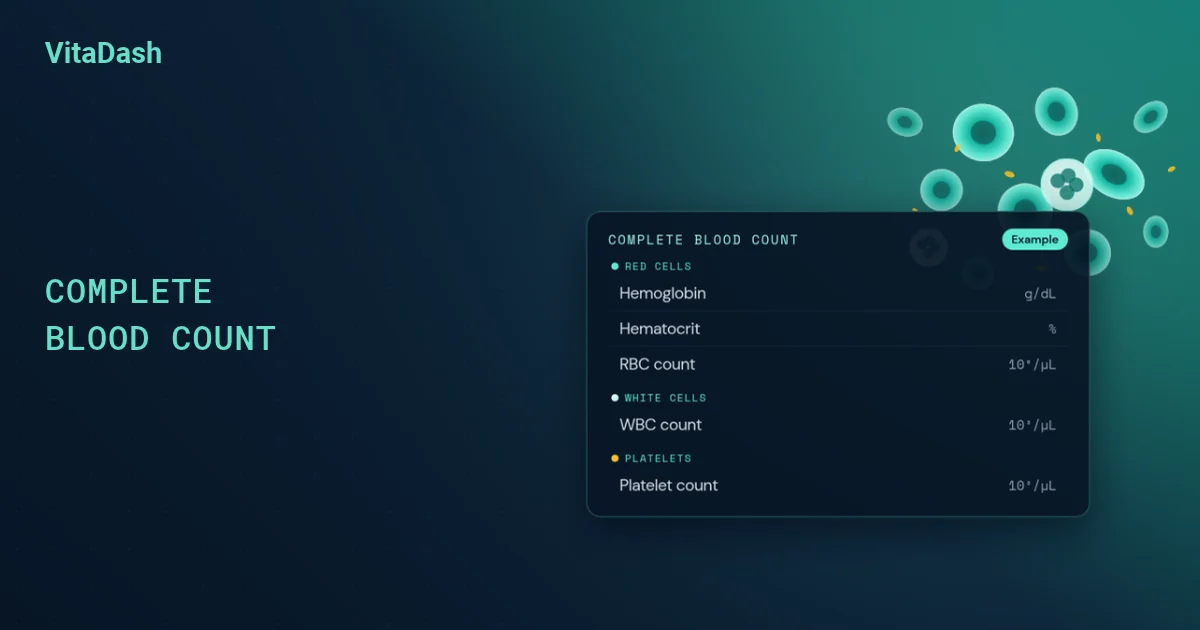
Reading a CBC (complete blood count) on a lab PDF
Key takeaways
- A complete blood count (CBC) is a common blood test that reports on three groups: red cells, white cells, and platelets.
- Each line has its own unit and a reference interval printed by the lab, and the same count can be written in different notations on different reports.
- An H or L flag compares the value with that lab’s printed interval. It is not a diagnosis.
- Clinicians usually read the CBC lines together, alongside history and earlier results, rather than one number at a time.
The CBC section of a lab PDF can hold a dozen or more lines, many of them short abbreviations. This page walks through how those lines are usually grouped, what each group refers to at a high level, and how to read the units and printed intervals. It does not set a personal target or tell you what to change.
Educational information, not medical advice. Discuss your results with your doctor.
What a complete blood count measures
A CBC counts and measures the cells in a blood sample. Red blood cells carry oxygen using a protein called hemoglobin. White blood cells are part of the immune system. Platelets are small cell fragments involved in clotting. A laboratory analyzer reports counts and sizes for each group, and the report prints them as separate lines. Some reports call the same test a full blood count.
How the lines are usually grouped
Many reports print the red cell lines first, then the white cell lines, then platelets. Some labs add a white cell differential, which splits the white cell count into types. Names vary between labs, so the same line can appear as RBC, Red blood cell count, or Erythrocytes.
- Red cell lines: hemoglobin (Hgb or Hb), hematocrit (Hct), red blood cell count (RBC), and the red cell indices MCV, MCH, MCHC, and RDW.
- White cell lines: white blood cell count (WBC) and, on a differential, types such as neutrophils and lymphocytes, shown as a percentage, an absolute count, or both.
- Platelet lines: platelet count (PLT) and, on some reports, mean platelet volume (MPV).
Red cell indices in plain language
MCV is the average size of the red cells. MCH is the average amount of hemoglobin in each red cell, and MCHC is the average concentration of hemoglobin inside red cells. RDW describes how much red cell size varies across the sample. Clinicians usually read these indices together with hemoglobin and hematocrit rather than on their own.
Units and reference intervals
CBC units are not the same on every report. A white cell or platelet count may be printed as 10³/µL, K/µL, or 10⁹/L, which give the same number in different notation. Hemoglobin may be printed in g/dL or g/L, and those differ by a factor of ten. Reference intervals differ by laboratory, method, age, and sex. The interval printed on the PDF is the comparison that applies to that report.
Upload a blood-test PDF you already have for an educational walkthrough of what the PDF shows — then discuss results with your doctor. VitaDash does not diagnose or interpret results clinically.
Get free previewWhy one CBC line has limits
A single value outside the printed interval does not explain itself. Hydration, activity level, diet, medicines, a menstrual period, and a recent infection are among the factors that can affect CBC lines, and small differences between draws are common. That is one reason clinicians usually read the whole CBC together, compare it with earlier results, and consider why the test was ordered.
Questions to bring to a clinician
Writing questions down before an appointment can make the conversation easier. Examples:
- Which reference intervals apply to these CBC lines, and is any flagged value expected in this context?
- How do the red cell, white cell, and platelet lines on this report relate to each other?
- Is a comparison with earlier CBC results or a repeat test useful here?
Related biomarker pages
VitaDash has educational pages for many of the lines on a typical CBC:
- Hemoglobin: /biomarkers/hemoglobin
- Hematocrit: /biomarkers/hematocrit
- Red blood cell count: /biomarkers/red-blood-cell-count
- MCV: /biomarkers/mcv
- MCH: /biomarkers/mch
- MCHC: /biomarkers/mchc
- RDW: /biomarkers/rdw
- White blood cell count: /biomarkers/white-blood-cell-count
- Neutrophils: /biomarkers/neutrophils
- Lymphocytes: /biomarkers/lymphocytes
- Platelet count: /biomarkers/platelet-count
Sources
- MedlinePlus — Complete Blood Count (CBC): https://medlineplus.gov/lab-tests/complete-blood-count-cbc/
- MedlinePlus — Blood Differential: https://medlineplus.gov/lab-tests/blood-differential/
- MedlinePlus — How to understand your lab results: https://medlineplus.gov/lab-tests/how-to-understand-your-lab-results/
| CBC line (examples) | What it usually reflects (high-level) | Typical unit |
|---|---|---|
| Hemoglobin (Hgb) | Oxygen-carrying protein inside red cells | g/dL or g/L |
| Hematocrit (Hct) | Share of blood volume made up of red cells | % |
| RBC count | Number of red cells in a set volume of blood | 10⁶/µL or 10¹²/L |
| WBC count | Number of white cells in a set volume of blood | 10³/µL or 10⁹/L |
| Platelet count | Number of platelets in a set volume of blood | 10³/µL or 10⁹/L |
Some labs print counts as K/µL or M/µL. Units and intervals vary by laboratory; the interval printed on the PDF is the one that applies.
Upload a blood-test PDF you already have for an educational walkthrough of what the PDF shows — then discuss results with your doctor. VitaDash does not diagnose or interpret results clinically.
Get free preview