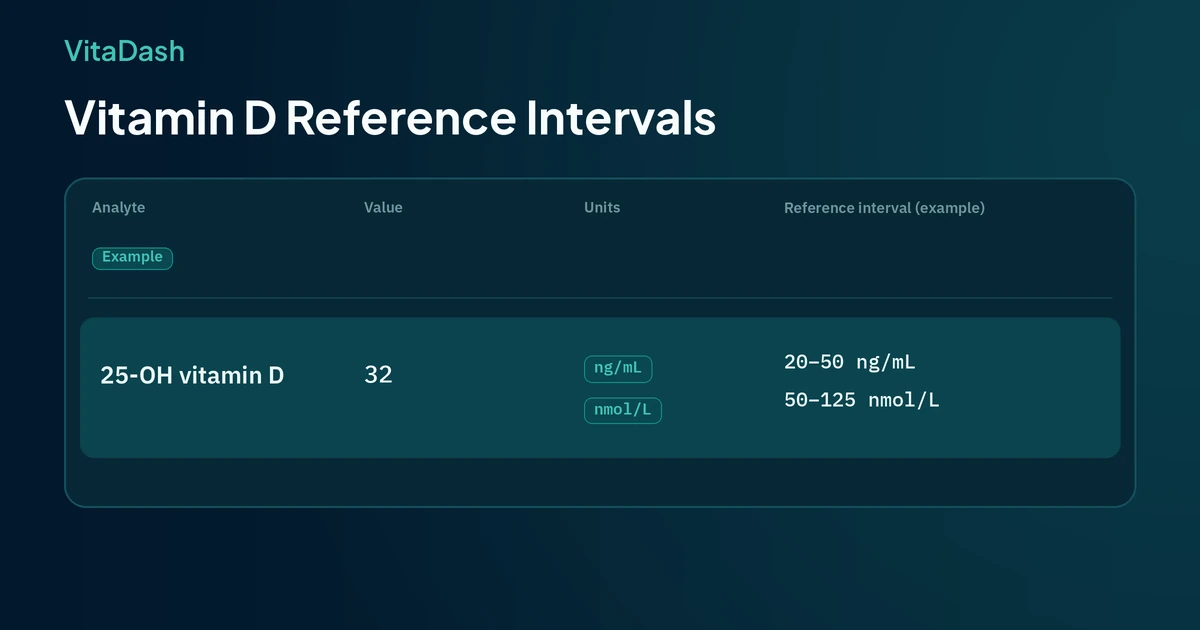
Lab reference intervals and vitamin D: educational context
Key takeaways
- The interval printed on your PDF belongs to that laboratory and method. It is not a universal “ideal” number.
- Guideline bands and clinical goals can differ from a lab interval. Only a clinician applies them to you.
- This page does not recommend products and does not label you from a table.
“In range” on a vitamin D line means the value sits inside the interval that laboratory printed for that assay. A clinician may still discuss a different target based on your history. Those two ideas — lab interval vs clinical goal — are easy to flatten into one internet number. This page keeps them separate.
Why intervals are not one number
Methods, units (ng/mL vs nmol/L), and the population a lab uses for its interval can differ. NIH ODS Table 1 (FNB/IOM 2011) publishes example educational bands; other professional groups have used other cut-points, and 2024 Endocrine Society guidance does not set those same routine sufficiency cut-points for healthy people. None of those tables diagnoses you.
Upload a blood-test PDF you already have for an educational walkthrough of what the PDF shows — then discuss results with your doctor. VitaDash does not diagnose or interpret results clinically.
Get free previewSources
- NIH ODS — Vitamin D (Health Professional): https://ods.od.nih.gov/factsheets/VitaminD-HealthProfessional/
- MedlinePlus — Vitamin D Test: https://medlineplus.gov/lab-tests/vitamin-d-test/
Reference intervals vary by lab
Example low band cited by FNB/IOM via NIH ODS
- nmol/L
- <30
- ng/mL
- <12
Example generally considered inadequate for bone/overall health in healthy people (FNB/IOM via NIH ODS)
- nmol/L
- 30 to <50
- ng/mL
- 12 to <20
Example generally considered adequate for bone/overall health in healthy people (FNB/IOM via NIH ODS)
- nmol/L
- ≥50
- ng/mL
- ≥20
Example potentially adverse effects from high concentrations (FNB/IOM via NIH ODS)
- nmol/L
- >125
- ng/mL
- >50
| Educational orientation (NIH ODS Table 1 / FNB–IOM 2011) | nmol/L | ng/mL |
|---|---|---|
| Example low band cited by FNB/IOM via NIH ODS | <30 | <12 |
| Example generally considered inadequate for bone/overall health in healthy people (FNB/IOM via NIH ODS) | 30 to <50 | 12 to <20 |
| Example generally considered adequate for bone/overall health in healthy people (FNB/IOM via NIH ODS) | ≥50 | ≥20 |
| Example potentially adverse effects from high concentrations (FNB/IOM via NIH ODS) | >125 | >50 |
These are example educational bands from NIH ODS Table 1 citing FNB/IOM (2011). Guidelines use different cut-points (IOM/FNB vs historical Endocrine Society; 2024 Endocrine Society guidance does not set those same routine sufficiency cut-points for healthy people; UK practice often uses nmol/L with local ~<25 / 25–50 / >50 nmol/L framing). Your lab’s printed reference interval on the PDF controls. These example bands do not diagnose you. Conversion: ~2.5 nmol/L ≈ 1 ng/mL (50 nmol/L = 20 ng/mL). Sources: NIH ODS Vitamin D — Health Professional (https://ods.od.nih.gov/factsheets/VitaminD-HealthProfessional/), NIH ODS consumer (https://ods.od.nih.gov/factsheets/VitaminD-Consumer/), MedlinePlus Vitamin D Test (https://medlineplus.gov/lab-tests/vitamin-d-test/).
Upload a blood-test PDF you already have for an educational walkthrough of what the PDF shows — then discuss results with your doctor. VitaDash does not diagnose or interpret results clinically.
Get free preview